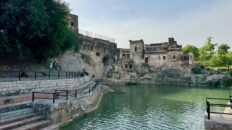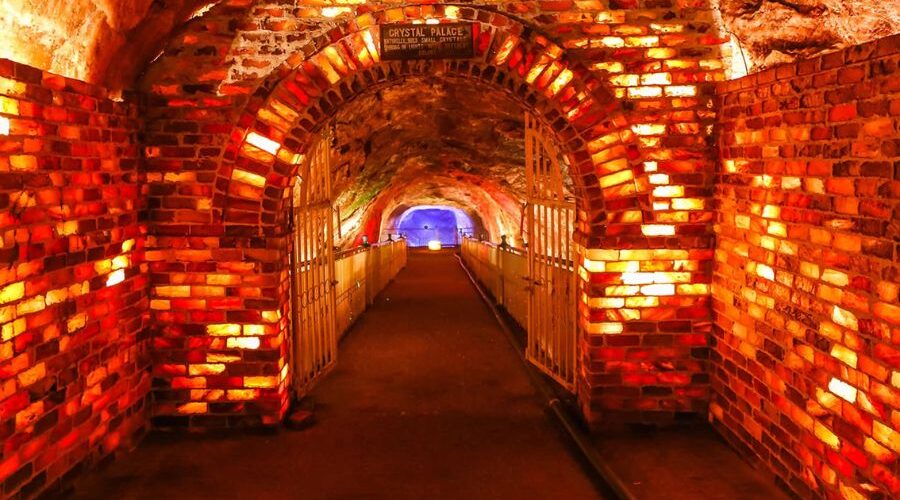
We had all been talking about it for months without actually doing it. Between work schedules and the usual excuses, a group of us kept saying we’d take a day trip to the Khewra Salt Mine in the Salt Range and kept not doing it. This time we finally made it happen. For me, the trip carried an extra layer. I had been to Khewra once before, back in 2006 or 2007, with my father. I was too young then to remember much of it; I only had a handful of old photographs to go by. I’d also lived in Sargodha for four years while my father was posted there, so the mine was never far away geographically, even if it stayed out of reach for two decades. This time, I wanted to actually see it, not just visit it, but understand it. For most of the group, though, it was a first. None of us really knew what to expect once we got past the entrance.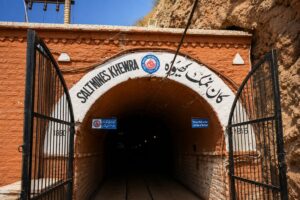
The welcome set the tone for the whole day. The mine’s management met us with a warmth that felt genuine rather than routine, the kind of hospitality that makes you relax before the tour has even started. It was a brutally hot day, the kind where standing outside for even a couple of minutes felt unbearable. So, when we boarded the small train that carries visitors into the mine, the change was immediate. Within minutes, the heat gave way to a cool, almost pleasant air inside the mountain. Stepping back out into the sun a few hours later, after getting used to that underground chill, made the heat feel even worse than before.
Once inside, a tour guide walked us through the mine’s history, and it turned out to be more layered than any of us expected. He started with a comparison most visitors probably don’t know: the world’s two most famous salt-mining sites aren’t the same place. In Poland, the Wieliczka Salt Mine near Kraków is the one tourists know best, while the Kłodawa Salt Mine, also in Poland, actually holds the title of the country’s largest. Khewra, our guide explained, is often cited as the second-largest salt mine in the world, and it’s the source of the pink Himalayan salt that ends up on dinner tables far beyond Pakistan.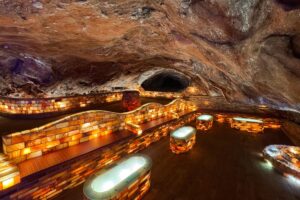
The story of how it was found is part history, part legend. According to the account passed down and repeated by guides at the site, the mine’s existence came to light around 326 BC, during the period when Alexander the Great’s forces were in the region. The story goes that the horses in his army were found licking the salty rocks in the area, which is what first drew attention to what lay beneath. Serious, organized extraction came much later; the British administration began mining the salt on scientific lines in 1849, and in 1872 a mining engineer named Dr. H. Warth oversaw the digging of a major shaft that’s still in use today. What struck me most was the scale and the engineering logic behind it. The mine runs across 17 levels, cut deep into the mountain, and only about half of the salt is actually extracted. The rest is deliberately left behind in the form of pillars, which is the only thing keeping those 17 levels from collapsing in on themselves. It’s a slow, careful process. Khewra produces somewhere between 350,000 and 400,000 tonnes of salt a year, which sounds like a lot until you consider it’s been mined for well over a century.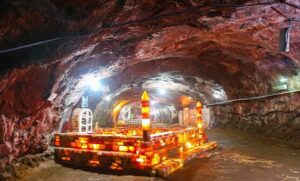
We ended up spending more than three hours underground, and it didn’t feel like enough. The mine has been shaped, quite literally, into a small world of its own. There’s a mosque built entirely out of salt bricks, along with scaled versions of the Minar-e-Pakistan and the Badshahi Mosque, also carved from the same material. Our guide mentioned that a salt replica of the Lahore Fort is currently under construction and should be ready before too long. There’s a dining area furnished with salt-brick sofas and tables, where we stopped to sit for a few minutes and take pictures. Further along, there’s a spot built specifically to catch and throw back sound, an echo point where your own voice comes back to you off the walls of the mountain. For anyone who gets hungry or just wants a break, there’s a small cafe inside the mine serving fries, chips, and tea. Just past it, a row of stalls sells salt lamps, blocks of pink salt for cooking, and other souvenirs carved from the same rock that surrounds you the entire time you’re inside. We moved through the later part of the tour faster than I would have liked, mostly because we had Katas Raj Temples on the itinerary for later that day and the clock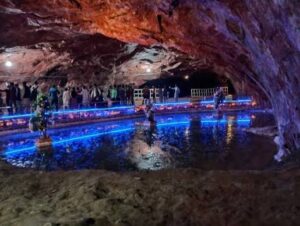 wasn’t on our side. If I’m honest, I wished we’d blocked out more time just for the mine alone. Between the history, the craftsmanship built into the walls, and the sheer hospitality we were met with from the moment we arrived, Khewra turned out to be far more than a quick stop on a day trip. It’s the kind of place that rewards slowing down. If you haven’t been, it’s worth putting on the list, and if you’re only going once, don’t rush it the way we had to.
Beyond being a tourist attraction, Khewra Salt Mine represents one of Pakistan’s most valuable natural resources. The pink Himalayan salt found here has worldwide recognition, but there is a need to focus more on modern processing units, value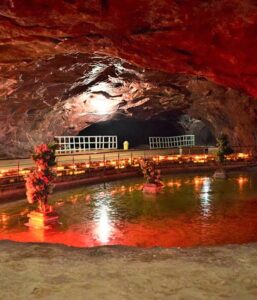 addition, and better branding within Pakistan. Instead of exporting mainly raw salt, investment in local processing facilities can help Pakistan create finished products, generate employment opportunities, and gain greater economic benefits from its own resources.
The Pakistani government should take stronger steps to preserve and develop this national treasure. Khewra is not just a mine; it is a part of Pakistan’s natural heritage and has the potential to play a greater role in the country’s economy if managed with proper planning and vision.